The Unfinished Archive: What families Preserve Before History Knows it Matters
KEENE.PRESS / KeeneOnArt
Artistic histories often begin outside institutions, among the photographs, objects, documents and recollections that families preserve without knowing what their eventual significance may be.
An artist’s archive rarely begins as an archive.
It begins with things kept. A photograph placed in a drawer. A letter folded into a book. A painting whose location is remembered but never recorded. An exhibition invitation, a studio notebook, a handwritten inscription, or a story repeated within a family long after the circumstances that produced it have disappeared.
Such material may remain undisturbed for decades. Its survival is often incidental rather than deliberate, shaped by attachment, circumstance, and sometimes simply by the reluctance to discard something that once belonged to another person. Only later does its historical value become apparent. By then, some of the people who understood its meaning may no longer be present to explain it.
The distance between what a family preserves and what an institution later recognizes raises a question: what happens to the evidence of an artist’s life before anyone considers it worth archiving?
I. Before the Museum
Institutional archives organize material through names, dates, classifications, collection numbers and provenance histories. Such systems are necessary: they make objects accessible and allow their relationships to be studied. Yet the circumstances through which those objects first survive are rarely so orderly.
A family may retain paintings without recording their titles. Photographs may become separated from their negatives. Correspondence may pass between relatives without anyone deciding that it constitutes an archive. A small study may remain in a family because it was personally meaningful while a major painting disappears into an undocumented private collection.
What eventually enters a museum is therefore not necessarily a complete representation of a life or practice. It is the material that survived. That survival depends not only upon artistic achievement, but also upon the ordinary decisions of those who kept, moved, inherited, or discarded its evidence.
II. What Families Know
Families retain forms of knowledge seldom encountered in exhibition catalogues: the identity of a sitter, the circumstances of a commission, the reason a work was given away, the name of a place remembered differently in public records. These memories can provide essential context, but familiarity should not be confused with certainty.
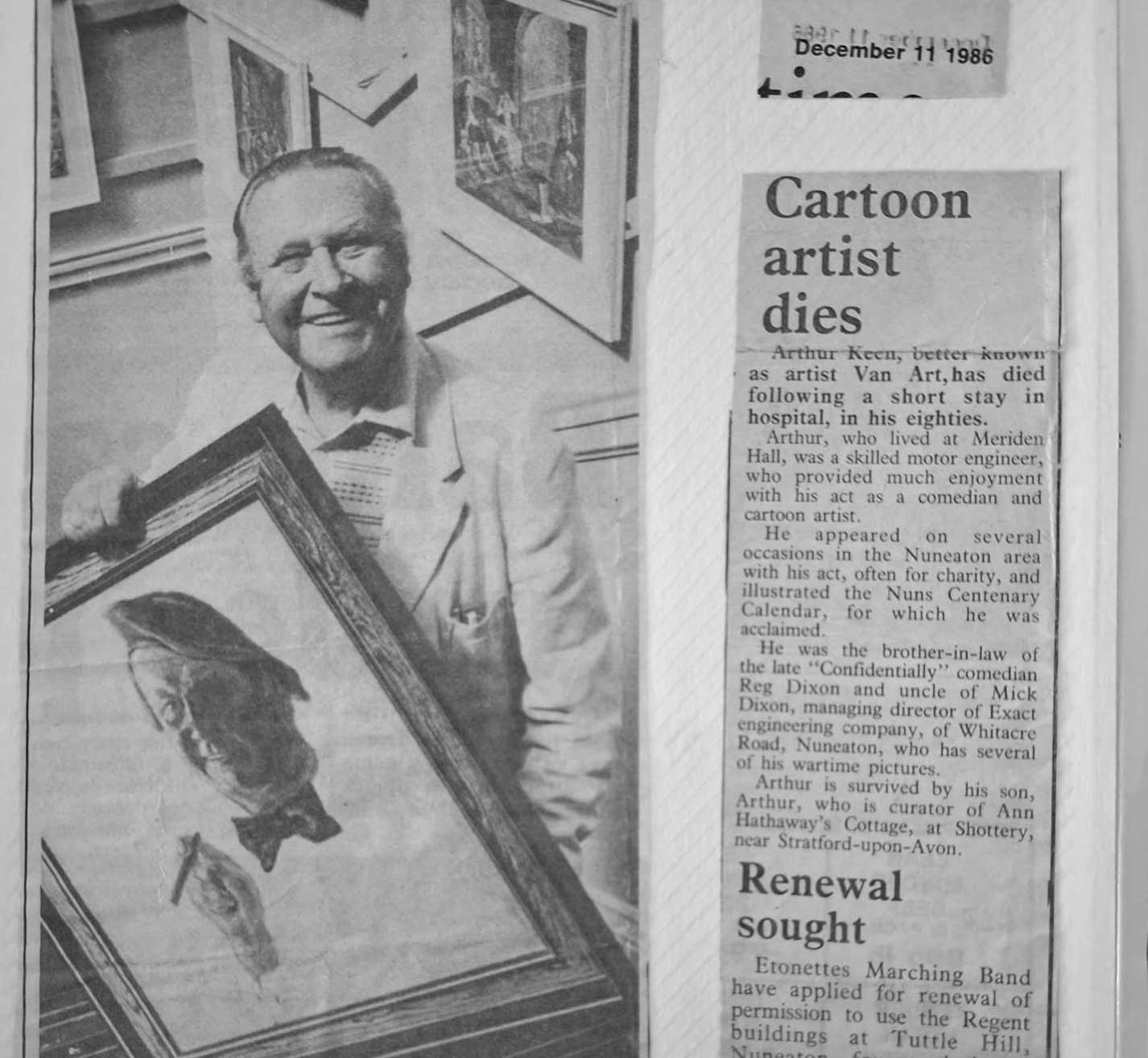
Recent research into the life of Arthur Keene (1900–1986), known professionally as Van Art of Coventry, demonstrates how an archive may reopen through an unexpected encounter. A message placed on the Historic Coventry Forum in August 2026, seeking information about paintings by Van Art and his son Arthur Keene, prompted a September reply from Roger Male. Male wrote that his mother had been close to the artist during his later life, and described photographs, a sketch and a painting connected to that relationship.
The renewed contact led to historical press clippings. In an article titled “Drawing on best of both worlds,” Ron Harding reported that about 300 paintings by Van Art were held in private homes or other collections, with works dispersed across several countries. The figure is a newspaper estimate, not a verified catalogue of an artist’s total production or a count of works known to survive. Nevertheless, it opens an important research question: how much of the practice remains beyond the family’s present documentation?
A separate Coventry Standard clipping dated 5 September 1964 describes a substantial mural for the Rainbow Inn in Allesley. The two clippings do not complete the artist’s history. They demonstrate how newspaper fragments, personal recollection and the initiative of a later generation can bring otherwise disconnected evidence into view.
For the Keene lineage—Van Art, his son Arthur Keene, and his grandson Tobias Keene—continuity of artistic practice should not be mistaken for an uninterrupted or fully documented history. The same principle applies more broadly: a family archive can preserve knowledge that institutions do not hold, while still containing omissions and unresolved accounts.
III. Memory Is Evidence, but Not Proof
Personal recollection is among the most delicate forms of archival evidence. An event may be vividly and sincerely recalled while remaining difficult to verify through surviving records. Another witness may remember it differently. Neither account necessarily deserves to be discarded.
Memory reveals how experience has been retained and understood, but it is not automatic proof that an event occurred in precisely the way it is remembered. An artist’s attributed remark should remain attributed testimony. A date inferred from a photograph should not be presented as a documented fact. Contradictions can be recorded rather than concealed.
There is a particular temptation, when constructing a public artist biography, to make gaps disappear. Uncertain dates become definitive; incompatible anecdotes are compressed into a single continuous story. The resulting history may be easier to read, but less faithful to its evidence.
An archive does not become more authoritative by appearing more complete than it is. Its integrity depends upon preserving the distinction between what is documented, what is remembered and what remains uncertain.
IV. What the Object Knows
An artwork preserves information independently of the stories told about it. Its reverse may carry inscriptions, gallery labels, inventory numbers, transport marks or evidence of former framing. A photograph may survive with a negative, contact sheet, original caption, or sequence of exposures that clarifies circumstances invisible in the finished print.
Such evidence can confirm a recollection or challenge it. A remembered title may differ from an inscription; an assumed date may conflict with an exhibition record; an old studio photograph may reveal a painting whose location is now unknown.
The object is not merely an illustration of family history. It is part of the evidence through which that history can be tested and reconsidered. Even an apparently minor document can become consequential when it establishes a connection between two otherwise separate records.
V. The Missing Pieces
Every archive is shaped by absence. Works are lost, sold, destroyed or given away. Photographs remain unidentified. Exhibition invitations survive without catalogues. The names of people who guarded documents or assisted an artist may never enter the formal record.
These gaps reveal something about the conditions of preservation: whose lives were documented, who had the resources to keep materials, and who determined which objects were worth retaining.
An unidentified photograph should not acquire a speculative identity merely to complete a catalogue. An uncertain date should remain provisional. An incomplete archive, honestly described, is more valuable than a seemingly seamless account built upon unsupported assumptions.
VI. The Next Generation
The continuing project Photo Kegham of Gaza: Unboxing an Unfinished Archive offers a powerful example of photographic material reconsidered by a later generation. Kegham Djeghalian Sr., a survivor of the Armenian Genocide, established a photographic studio in Gaza in 1944 and photographed the city and its inhabitants over several decades.
In 2018, three boxes holding hundreds of his photographs and negatives were rediscovered in a family home in Cairo. His grandson, the visual artist Kegham Djeghalian Jr., later developed this material into an ongoing artistic and archival project. His account emphasizes that classification and display are interpretive decisions, not neutral acts.
The project has particular historical circumstances—Armenian displacement, Palestinian cultural history, and the fragility of records in Gaza—that should not be flattened into a universal parable about family keepsakes. Yet it illuminates the broader responsibility of later custodians: those who inherit an archive must also decide how to describe it, what remains uncertain, and whose voice can be heard through it.
The next generation does not simply inherit an established history. It inherits material requiring new attention, research and interpretation, and thereby becomes part of the archive’s continuing history.
VII. Before History Knows It Matters
An artistic archive is not completed merely because its contents have been photographed and catalogued. Newly identified works may return to view. A conversation may clarify an inscription. A photograph may connect an artist, a place and a particular body of work. Equally, a long-accepted account may have to change.
For families and studios, this creates a responsibility in the present. Living witnesses can be invited to record their recollections while they are still able to do so. Objects can be examined before they are dispersed. Contradictory testimony can be attributed rather than silently resolved. Preservation need not imply that every private document must be made public; privacy, consent and the interests of others remain part of responsible custodianship.
We cannot reliably predict which letter, negative, sketch, painting or studio object will matter to a researcher fifty years from now. The task is not to predict history perfectly. It is to preserve enough evidence, and enough of its context, that future generations can ask their own questions.
An archive does not begin when history recognizes its importance. It begins when something is kept—and when enough of its context survives for someone else to understand why it might matter.
Selected references
Institut français — Photo Kegham of Gaza; original September 1 K.I.R. source
Historic Coventry Forum — public forum index
Additional archival sources: Ron Harding, “Drawing on best of both worlds” (date and newspaper to be established); Coventry Standard, “Passionate Pensioners,” 5 September 1964; Historic Coventry Forum posts signed Tobias Keene (19 August 2026) and Roger Male (17 September 2026). The private correspondence and any public identification beyond the existing forum material require permissions review.
Editorial research date: 1 September 2026. Manuscript completed for review: 17 October 2026. Publication date: not assigned. Publication permission and final image selection: pending.