


When Provenance Means More Than Ownership
KeeneOnArt | KEENE.PRESS
An artwork carries more than a chain of possession. Its material surface, reverse, inscriptions, photographs, records and human recollections form part of the evidence by which its life can be understood.
Provenance is usually described through ownership: where an artwork has been, who possessed it, when it changed hands, and how those movements can be documented. That history matters. It can support attribution, establish continuity, clarify title, and situate a work within collections and exhibitions.
But ownership is only one part of an artwork’s biography.
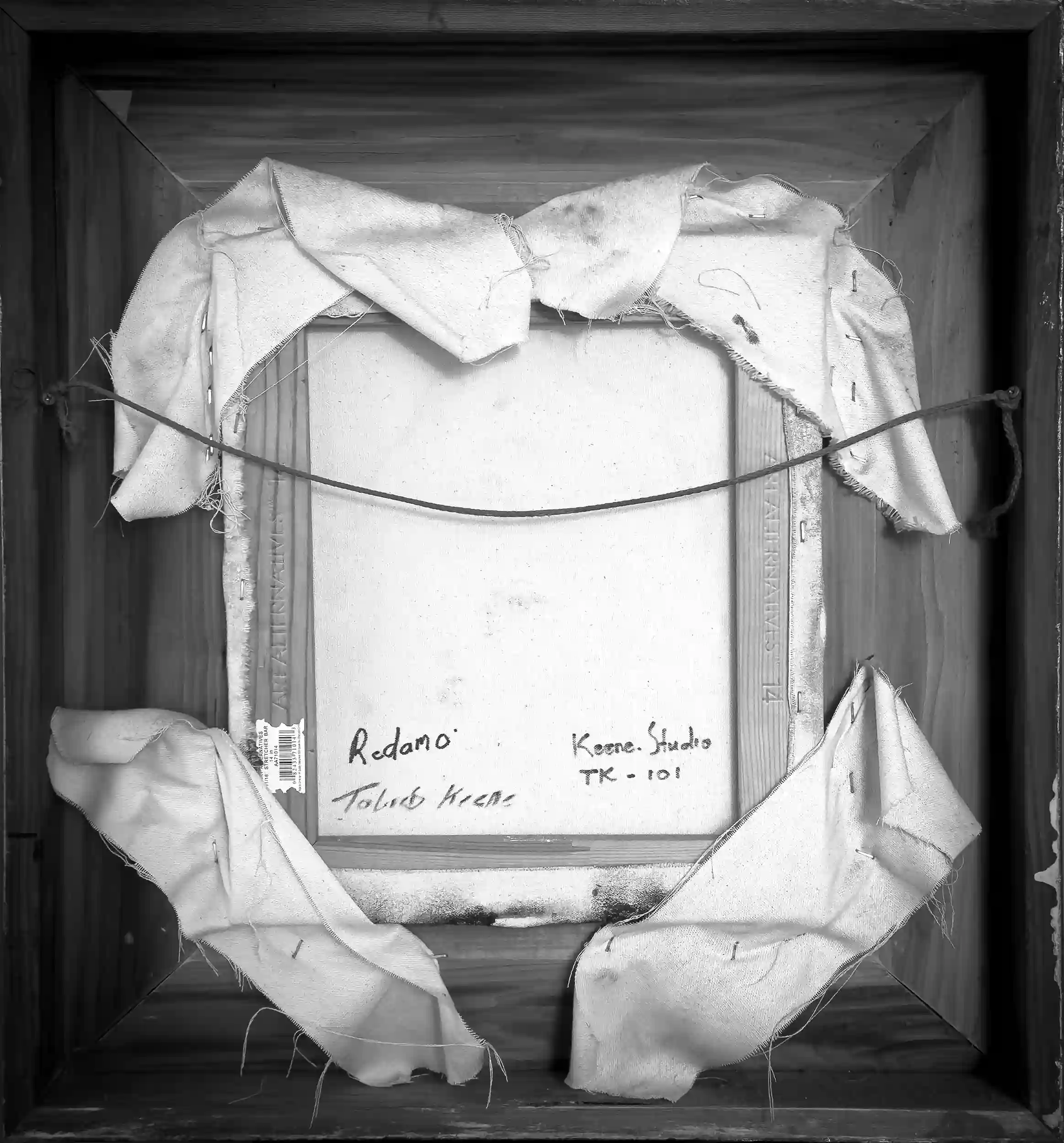
A painting is also a physical object. It has a front that was made to be seen and a reverse that was rarely intended for public attention. Yet the reverse can preserve evidence the image itself cannot: labels, inscriptions, inventory marks, old framing decisions, transport traces, repairs, hardware, remnants of previous presentations and sometimes the handwriting of the artist or collector.
The surface itself can hold another kind of evidence.
Conservation and close examination have revealed fingerprints, hand marks, brush hairs and other physical traces left during the making of paintings. Such discoveries can bring us unexpectedly close to the act of creation. A fingerprint impressed into wet paint is no longer merely an imperfection in the surface. It is evidence of touch — a moment when the artist’s hand and the object were quite literally in contact.
For painter Tobias Keene, this physical connection is part of the fascination of an artwork.
The thought of discovering a trace of the artist within the surface — a fingerprint, a hair, some small remnant of the act of making — is not something he regards as a defect to be regretted. Quite the opposite. To encounter such a trace in a painting made centuries ago is to encounter something extraordinarily immediate: evidence that the object before us once existed beneath the artist’s hand.
Imagine, Keene suggests, discovering such a trace in a Rembrandt or a Leonardo. The distance of centuries suddenly contracts. What might otherwise appear incidental becomes intensely human.
There are historical examples that make the idea more than hypothetical. Fingerprints have been documented in paintings associated with Rembrandt, alongside broken brush hairs embedded in paint. Leonardo’s fingerprints and hand-worked passages survive in works attributed to him, recording moments in which fingers or palms were used directly on the surface.
These traces may or may not alter the financial value of an artwork. That is almost beside the point.
Their value can instead be experiential.
They remind us that a painting was not always an art-historical object, a catalogue entry, an asset or an image on a screen. Once, it was wet paint in a studio. Someone stood before it. Someone touched it.
The difference becomes particularly clear when works return temporarily from a private collection for documentation. Photographing the front is expected. Photographing the reverse can be revelatory. Suddenly the object is no longer only an image or an entry in a sales record. It becomes a layered historical document.
For a studio or archive, that distinction matters. A useful record can include the complete front and reverse; signature and inscriptions; medium and support; dimensions; frame and mounting; labels and marks; condition at the time of examination; the date and location of documentation; earlier photographs; exhibition and publication history; correspondence; and recollections that can still be attributed to people who witnessed the work’s movement through the world.
None of this replaces provenance in its established scholarly, legal or market sense. Rather, it suggests that responsible documentation can preserve a wider field of evidence around the object. Ownership chronology tells us one kind of truth. Material evidence and archival context can tell us others.
This may matter increasingly in a culture saturated with frictionless images. A digital image can travel instantly and detach almost completely from the circumstances of the object it represents. The artwork itself remains stubbornly specific: a certain support, a certain edge, a certain reverse, a certain history of handling and keeping. The closer images move toward abundance, the more valuable that specificity can become.
There is also a human layer. Collectors remember where a work hung, when it arrived, why it mattered, or what the artist said when it changed hands. Studios remember framing decisions, alterations and exhibitions. Family archives retain photographs, letters or anecdotes that may never have entered a catalogue. These recollections require care — memory is not the same as documentary proof — but when recorded and attributed properly, they can help future researchers understand the circumstances around an object.
Perhaps provenance, then, can be thought of not only as a chain of ownership but as a chain of evidence.
Who held the work is part of that chain. So are the marks the object carries, the records created around it, the places it has occupied, the traces left during its making, and the people able to testify to its history.
The front of a painting tells us what the artist placed before us.
Sometimes the surface tells us something about the artist who stood before it.
And the back may tell us something about what happened afterward.
All of it deserves to be preserved.